Svarvargatan 2, SE-112 49 Stockholm +46 (0)8-651 84 26 info@filmform.com Newsletter MORE

HIDE

Hägringen
BY
Peter Weiss

Hägringen is director Peter Weiss’s only feature-length film, and elements from his earlier experimental and non-fiction shorts come together in this remarkable city film about a young man’s 24-hour encounter with Stockholm. The beautiful opening sequence, in which the protagonist enters into the city via deserted highways and bridges, passing through an industrial landscape in the early morning mist, evokes a Stockholm rarely depicted on the screen, and introduces an unusual kind of city symphony. To a large extent, the film avoids the clichés of the city awakening – with shops and market stalls opening, and overcrowded rush-hour public transportation – and instead focuses on the man’s attempts not only to enter the life of the city but society in general, whose codes and meanings elude him. On his quest to find a place for himself, and his literally attempt to be a pillar of society, he finds himself in the midst of a huge construction site, and the film thus also becomes a document – stunningly shot by cinematographer Gustaf Mandal – of the remodelling of the city centre, a process that ravaged Stockholm in the late 50s and early 60s. Hägringen was a long-planned project for Weiss. He had published a draft of the film in the trade paper “Biografbladet” in 1947, five years before he ventured into filmmaking with his first experimental shorts. Weiss and his collaborators produced the film themselves, together with studio Svenska AB Nordisk Tonefilm, and Weiss revealed in interviews that the financing of the raw stock for the shooting was secured thanks to a contribution from the magazine “Film Culture”. The film was shot in late 1958 and early 1959, and was released in November 1959, playing for just ten days in a small Stockholm theatre. The protagonist of the film is played by Staffan Lamm, later to become a filmmaker in his own right, who documented the proceedings of the Russell Tribunal on the Vietnam War, which was held in Stockholm in 1967.

– Jon Wengström.

Aspect ratio 1.37:1 (Academy)
Prod. format Generic film
Duration 01:18:50
Language Swedish
Color BW
Year 1959
Latest screening Dec 16, 2025
Rent this work for public screenings

About the artist

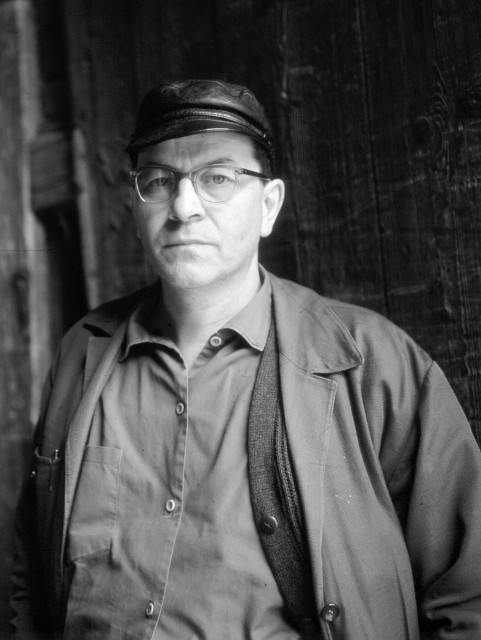
Peter Weiss

Peter Weiss (1916–1982) was born in Potsdam, Germany, and died in Stockholm, Sweden. His life was conditioned by travels and transitions, voluntary as well as involuntary.

He lived in Bremen, Berlin, Chislehurst and Prague. Right before World War II his family – on his father’s side of Jewish origin – had to go into exile in Sweden. He became a Swedish citizen and tried to integrate into Swedish cultural life. Peter Weiss was trained at the Art Academy in Prague, and he was also a promising writer (inspired by Herman Hesse among others), but neither his visual art, nor his prose in Swedish (a language which he soon mastered) led to success or even acknowledgment in the new country. Instead, it was the avantgarde film culture that became his privileged scene.

In the 1950s he joined The Film Workshop (now known as Filmform) in Stockholm, by then an early avantgarde co-op, consisting of young artists and poets. Few of them had any background in filmmaking, but they were all heavily influenced by continental and American avantgarde film. Together with the other artists in the co-op he made a series of experimental shorts that had some success at the festival circuit internationally. At the same time he was established as a maker of commissioned films (both poetic documentaries and information films). Weiss visited Paris and the screenings of experimental films at the Cinémathèque Française. His critical essays and introductions to these films were published in newspapers and magazines, later collected in the volume Avantgardefilm 1956 (published by Wahlström & Widstrand). These circumstances made him for some years to the leading profile within Swedish experimental film culture. This trajectory culminated – and in a way met an end – with his Surrealist feature film Hägringen (Mirage) in 1959. The film was supported by among others Jonas Mekas, and was an ambitious attempt to create a new filmic language, characterized by the dreamlike logics of Surrealist art in combination with a clear documentary style. The critical reception was harsh, and even though Peter Weiss tried some more filmmaking in the beginning of the 1960s, he soon turned into being an internationally acknowledged novelist and playwright in the German language instead. Most notably with political plays as Marat/Sade (1963) and the Investigation (1965), as well as with the remarkable novel The Aesthetics of Resistance, published in German in three volumes (1975–1981) and soon translated into several languages. He left filmmaking during this period, but there are reminiscences of his love for avantgarde film integrated in the philosophical and political discussions that form the core of this great last novel.

As a filmmaker Peter Weiss was heavily influenced by the avantgarde of the 1920s, but he succeeded in creating a style of his own through his eye for the everyday realities that surrounded him, something which actually makes his filmic dreams even more convincing, though they were produced with low budgets. His visions remain vital contributions to the Swedish – and European – experimental film culture.

– Lars Gustaf Andersson

WORKS BY SAME ARTIST

SHOW ALL WORKS